
Real magic happens when you're not looking. Turn your attention to the trick, and that magic is lost - though we think we want to know, we never truly do. You likely weren't looking for, nor expecting, real movie magic when you sat down to your favourite film, the one most likely to evoke a sense of satisfaction and nostalgia in your memory. Steven Spielberg trades in this stuff regularly, and herein lies the issue: he wants to evoke those same senses in his audience, but the production of nostalgia relies upon the reproduction of an experience in the mind, and it's impossible to reproduce an experience in the same moment in which it's occurring. Thus, The BFG, which is so overtly an attempt to actively produce nostalgia, comes across more as a magic trick with all the sleight of hand made manifest in its every movement, rather than the real movie magic to which it aspires. The technique is strong, the execution stronger still, but the purpose is corrupt. The film is better when it lays off the wonder and whimsy, and hones in on character. A most British film in style and tone when dialogue takes over, here is where this most American director finds his feet. The BFG exploits the charm of Roald Dahl's prose and the skill of actor Mark Rylance to create a work that's as affable and heartwarming as it's intended to be. It's a broad comedy adventure in the mould of a dramatic family film, and boldly commits to its wholesome British eccentricity. Spielberg's regular collaborators turn in smart work, from Rick Carter and Robert Stromberg's lovely production design to John Williams' score, one of his best in recent years.

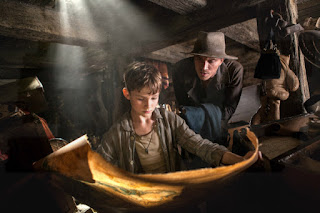
This is where things get ugly. And they certainly shouldn't - one glance at director Joe Wright's previous films and anyone would conclude that he's incapable of making an ugly film. It's not for want of effort, since Pan is a heavily designed film full of colour and light, only that it's so full of colour and light as to be suffocating in its visual schematics. Wright knows how to construct a memorable image, and how space and location can inform the mental and emotional impacts of a shot or a scene; would that Jason Fuchs' screenplay were as thoughtful. It follows a familiar narrative path with a familiar attitude toward character and dialogue, developing its set story with a sense of resignation to its inevitability. True, it's pretty obvious where Pan is destined to wind up, more so with each and every new development, but it ought not to be so obvious how disappointing that path to its conclusion must be. Wright's resignation to the screenplay is understandable - he's never been the most literate of filmmakers - but the sheer unattractiveness of his own approach is most unlike him; he seems to have sacrificed quality for quantity, simply filling the screen with razzle dazzle in the hope of creating the most sparkling 3D blockbuster experience. Uglier still is the soundtrack from John Powell, a heavy-handed attempt at resembling John Williams, blighted by the unfortunate decision to incorporate contemporary rock songs in the most cringeworthy way conceivable. Even uglier again is Pan's attitude toward race, apparent in its dismissal of a multi-racial ensemble of extras and its elevation of its white characters, not to mention the well-documented race reversal of key roles in a missed opportunity to correct the crassness of J. M. Barrie's text.


